

 English
 Español
Outdoor engineering HDPE two-tone sandwich sheet is built from two layers of HDPE in contrasting colors fused into a single sandwich structure, with a distinct surface tone over a differently colored ...


News
Home / News / Industry News / HDPE Monocolor Sheet: Thickness, Colour Match and Grade Guide for Buyers
HDPE Monocolor Sheet: Thickness, Colour Match and Grade Guide for Buyers
2026-10-16
Content
- 1 What an HDPE Monocolor Sheet Actually Is
- 2 Specifications Buyers Should Lock Down Before Ordering
- 3 Monocolor or Sandwich: Which Construction to Specify
- 4 Where HDPE Monocolor Sheet Earns Its Place
- 5 From Drawing to Delivered Sheet: An Ordering Sequence
- 6 Quality and Sourcing Risks Worth Checking
- 7 Frequently Asked Questions
A fabricator opens a delivery of 12 mm HDPE monocolor sheet, measures the first panel, and gets 11.4 mm at the edge. The colour looks right, the surface is smooth, and the batch passed inspection on paper. Two weeks later the routed bolt holes sit three millimetres off the steel jig they were designed for.
Monocolor HDPE is one of the simplest products in a plastics catalogue: a single pigmented compound extruded into a flat panel. That simplicity is exactly why the details matter. There is no decorative layer to absorb a mistake and no pattern to disguise a thickness drift, so the sheet is judged on measurable things rather than appearance.
Key point
Thickness tolerance, flatness, colour consistency between batches and surface finish decide whether a monocolor HDPE sheet does its job. Everything else is negotiation.
Jiaxing Xinsen Plastic Co., Ltd. has been extruding polyethylene sheet from its Jiaxing, Zhejiang plant since October 2001, producing HDPE, LDPE and PP sheet for buyers across China and export markets in North America, South America, Europe, Southeast Asia and southern Africa. Custom colour, size and surface texture work sits inside the standard offer rather than outside it.
What an HDPE Monocolor Sheet Actually Is
An HDPE monocolor sheet is a solid high-density polyethylene panel in which a single pigment is compounded into the resin before extrusion, so the colour runs through the full cross-section rather than sitting in a thin surface layer.
HDPE is a semi-crystalline polyethylene with a density between roughly 0.941 and 0.965 g/cm3. The pigment load is small, usually 2 to 4 percent masterbatch by weight, which is enough for an even opaque colour without changing the mechanical character of the resin. Black sheet for outdoor service normally uses carbon black as both the colourant and the primary UV barrier.
Definition
A monocolor HDPE sheet carries one colour through its entire thickness. It differs from natural HDPE, which contains no pigment and reads as a translucent milky panel, and from two-tone or tricolor sandwich sheets, which are co-extruded from two or three layers in different colours.
Because the panel is one material from face to core, it can be sawn, drilled, routed, hot-air welded and thermoformed with ordinary workshop tools. Cut edges do not need sealing.
| Sheet type | Colour structure | Typical fit |
| HDPE monocolor | One pigment through the full thickness | Panels that are cut, welded or scratched in service |
| Natural HDPE | No pigment, translucent milky tone | Food contact parts and linings where colour is not required |
| Two-tone sandwich | Two co-extruded colours | Furniture and play equipment with visible edges |
| Tricolor sandwich | Three layers with a contrasting core | Amusement facilities and architectural trim |
Specifications Buyers Should Lock Down Before Ordering
Five specifications decide whether a monocolor HDPE sheet will work: thickness and its tolerance, sheet dimensions and squareness, density, surface finish, and colour match.
0.941-0.965 g/cm3, typical HDPE density band
1-30 mm common extruded thickness range
+/-5% or +/-0.5 mm typical quoted thickness tolerance
2-4% pigment masterbatch loading by weight
Thickness is where most orders go wrong. A tolerance quoted only as a percentage is generous on a 25 mm sheet and tight on a 3 mm sheet, so ask for the limit in millimetres and agree where the measurement is taken. Edge readings and centre readings differ on the same panel, and the gap widens on wide sheets.
| Parameter | Typical range | Confirm in writing |
| Thickness | 1-30 mm | Tolerance in millimetres and the measuring points |
| Sheet size | 1220 x 2440 mm up to cut-to-size panels | Cutting tolerance and squareness |
| Density | 0.941-0.965 g/cm3 | Virgin compound or blended regrind |
| Surface | Smooth, matte or orange peel | Texture on one face or both faces |
| Colour | RAL or Pantone reference | Approved sample and batch allowance |
| Flatness | Depends on thickness and stacking | Pallet packing and cooling routine |
Ask for the thickness tolerance in millimetres, not only as a percentage, and keep the measuring positions identical for every batch. A 12 mm panel that reads 11.4 mm at the edge and 12.1 mm at the centre passes a percentage check and still fails on the bench. Our buyer's guide to HDPE sheet grades, thickness tolerances and sourcing covers the rest of the checklist.
Monocolor or Sandwich: Which Construction to Specify
Choose monocolor when the sheet will be cut, edge-finished, welded or scratched in service; choose a sandwich construction when the coloured edge itself is part of the design.
HDPE monocolor sheet
- Colour continues through the full thickness, so routed edges and scratches stay the same colour
- A single resin stream, which keeps regrind and recycling straightforward
- Custom colour runs stay flexible because only one compound has to be matched
- Sheet size, thickness and texture follow the standard extrusion programme
Two-tone and tricolor sandwich
- Co-extruded layers create a visible colour line along the edge
- Designers treat the contrasting core as a graphic element
- Skin and core can be formulated for different duties
- Higher setup complexity, so best suited to fixed colour combinations and longer runs
Rule of thumb: if a panel will be chamfered, welded or dragged across a site, monocolor keeps the colour continuous. If the edge is a feature the end customer will look at, a sandwich sheet can carry the extra cost.
Both constructions share the same base resin behaviour, so the decision is usually about appearance and process economics rather than mechanical performance.
Where HDPE Monocolor Sheet Earns Its Place
Monocolor HDPE sheet is used wherever a flat panel has to survive water, impact and repeated cleaning without a coating, a paint system or a rot treatment.
- Playground equipment: slide side panels, climbing panels, deck infill and safety guards, where low-temperature impact resistance and freedom from splintering matter
- Outdoor and waterproof work: signage backing, garden structures, animal enclosures, marine trim and dock bumpers
- Industrial panels: machine guards, tank covers, chute liners and cutting tables
- Materials handling: tote liners, bin dividers and conveyor wear strips
- Fabrication-heavy projects: CNC-routed parts, welded assemblies and thermoformed trays
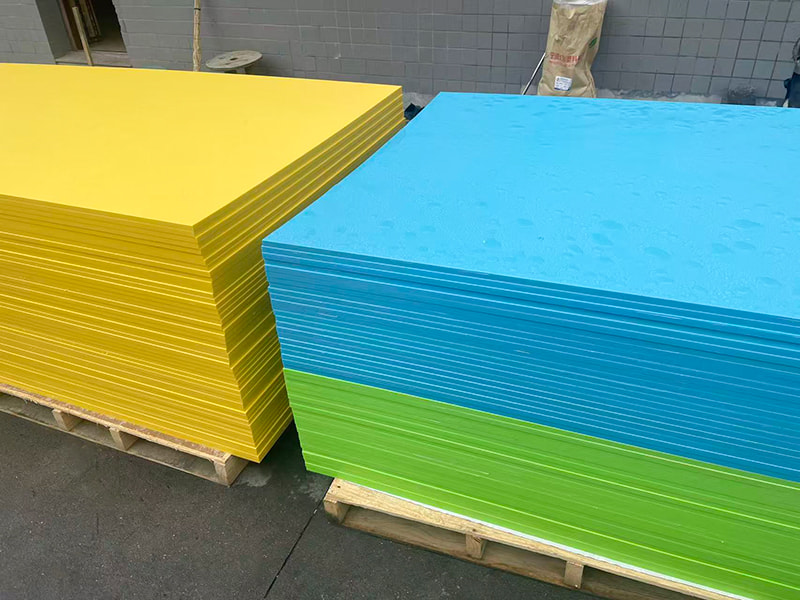 Playground Equipment HDPE Monocolor SheetA monocolor HDPE sheet for playground and outdoor panels, with color running through the thickness and resistance to impact, water, cleaning and weathering.View Product →
Moisture behaviour explains most of the switches from wood-based panels to HDPE. Standard HDPE absorbs well under 0.01 percent of its weight in a 24 hour soak, while exterior plywood and MDF take on water, swell and delaminate under the same conditions.
Relative moisture resistance of common panel materials
HDPE monocolor sheet
Very high
Exterior grade plywood
Moderate
MDF
Low
HDPE does not rot, does not need sealing at cut edges and does not splinter, which is why a monocolor panel often outlasts the frame it was bolted to. UV-stabilised grades are the exception to watch: unstabilised sheet will chalk and fade outdoors within a season or two.
 Waterproof Outdoor HDPE Monocolor SheetA fully waterproof, UV-resistant monocolor HDPE sheet for outdoor and marine use; its production sequence supports consistent colour and thickness across repeat batches.View Product →
From Drawing to Delivered Sheet: An Ordering Sequence
A repeatable six-step sequence keeps colour, thickness and delivery predictable across repeat batches.
- Define the duty: indoor or outdoor, UV exposure, chemicals, temperature range, load and span.
- Fix the drawing: thickness, sheet size, hole positions, edge treatment and the tolerance that actually matters.
- Choose surface and colour: a RAL or Pantone reference plus smooth, matte or orange peel finish, on one face or both.
- Approve a sample: a physical panel or colour chip, signed and retained by both sides.
- Agree on inspection: thickness measuring points, flatness, edge trim, protective film and packing.
- Confirm logistics: sheet size against pallet and container dimensions, plus the delivery schedule.
Keep the approved sample. Colour drift between batches is the most common complaint in sheet supply, and a retained sample turns a disagreement into a measurement.
Custom HDPE Monocolor Sheet Matched to Approved SampleA custom single-colour HDPE sheet with colour through the thickness, built to specified size, finish and sample match for repeatable outdoor panels.View Product →Quality and Sourcing Risks Worth Checking
Most monocolor HDPE complaints trace back to four causes: recycled content in the compound, thickness drift, colour variation between batches, and internal stress left over from cooling.
None of these show up on a one-page quotation. They show up three weeks after installation, when a panel bows, a fixing cracks, or a second batch arrives a shade darker than the first.
| Symptom | Likely cause | Question to ask |
| Panels bow within days | Stress from cooling or stacking warm sheet | What is the cooling and stacking routine? |
| Colour differs from the sample | Different masterbatch lot or pigment loading | Can the whole order run on one masterbatch lot? |
| Rough or wavy surface | Die condition or heavily blended regrind | Is the compound virgin or blended? |
| Cracks around fixings | Over-tightened fixings with no expansion allowance | What hole clearance do you recommend? |
| Faint odour | Contaminated regrind | What grade and origin is the compound? |
Design for movement: HDPE expands by roughly 1 to 1.3 mm per metre for every 10 degrees Celsius of temperature change, so oversized holes and slotted fixings are standard practice on long panels.
Frequently Asked Questions
Quick answer: an HDPE monocolor sheet is a single-pigment panel with colour through the full thickness, suited to outdoor, fabricated and impact-exposed work. Specify thickness tolerance in millimetres, confirm the compound is virgin where it matters, and approve a colour sample before production.
Is HDPE monocolor sheet the same as coloured HDPE sheet?
In practice, yes. Monocolor describes the structure: one colour through the entire thickness. The term separates it from natural HDPE, which contains no pigment, and from two-tone or tricolor sandwich sheets, which carry a contrasting core.
What thickness should I order for playground panels and outdoor cladding?
Cladding, signage and small guards usually run 6 to 12 mm. Structural play panels, deck infill and unsupported spans over about 600 mm generally need 12 to 20 mm, because stiffness rises quickly with thickness. Confirm the span and fixing pattern before fixing a number.
Can monocolor HDPE sheet be welded?
Yes. Hot plate, hot air and extrusion welding all work with HDPE, and a colour-matched weld rod keeps the joint visually continuous. Welded assemblies do not need sealant at the joint.
Will the colour fade outdoors?
UV-stabilised compounds slow chalking and fading considerably. Black sheet with a carbon black loading of roughly 2 to 2.5 percent holds colour best; light colours and thin sheets show change sooner, particularly in high-UV locations.
Related products
-
-
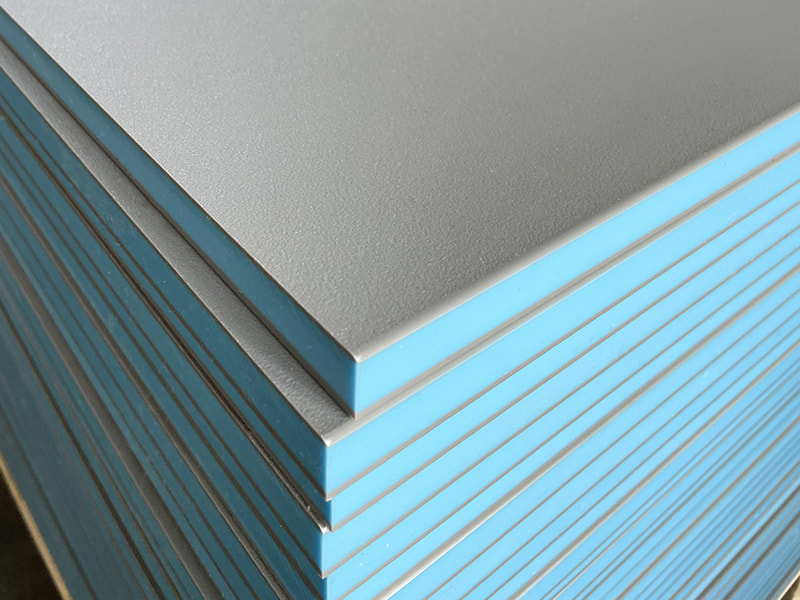
Children's Products Eco-friendly HDPE Two-Tone sandwich sheet is specifically developed for child-related products, combining two layers of contrasting-colored HDPE into a single sandwich structure wi...
-
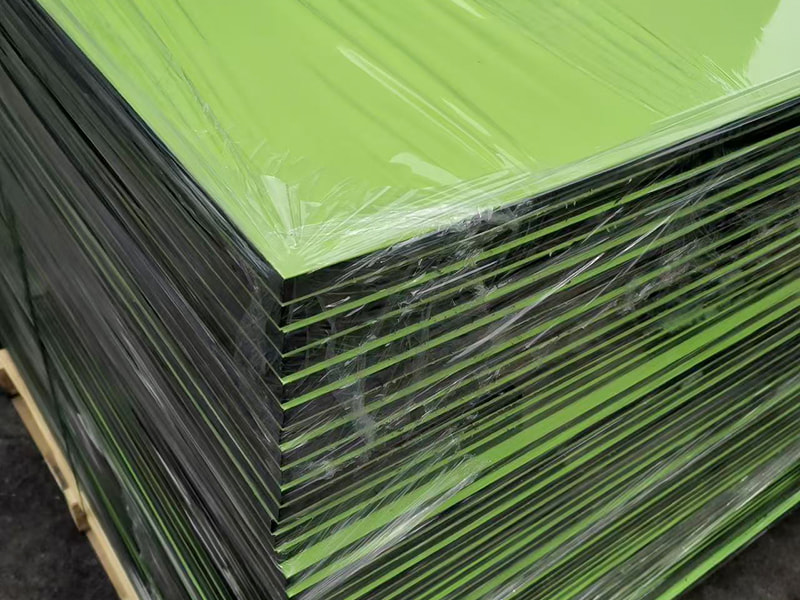
Indoor & Outdoor HDPE Flame-Retardant Dual-Color Sandwich Sheet builds on the standard dual-color sandwich structure by specifically reinforcing fire-retardant performance, allowing it to meet str...
-
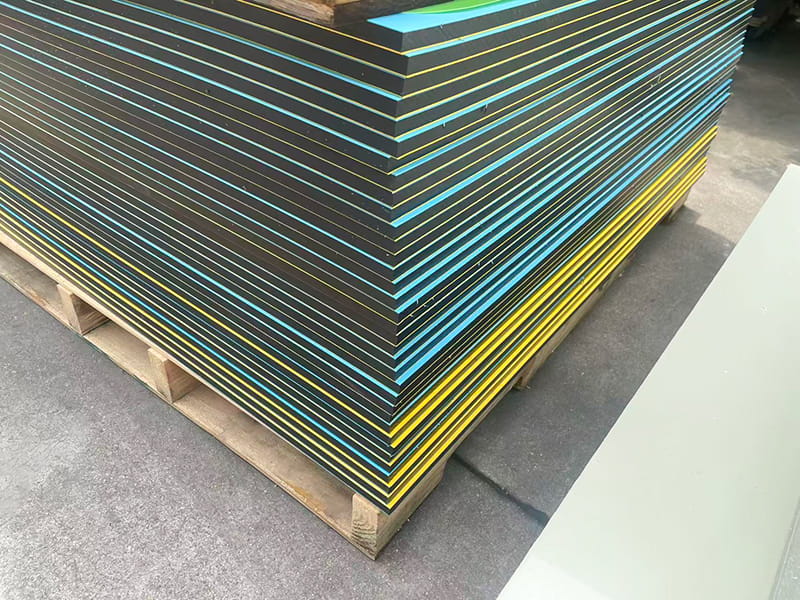
Amusement Facilities Child-Safe HDPE Tri-color sandwich Sheet is built from three layers of differently colored HDPE fused into a single specialized sandwich structure, allowing layered engraving or r...
-
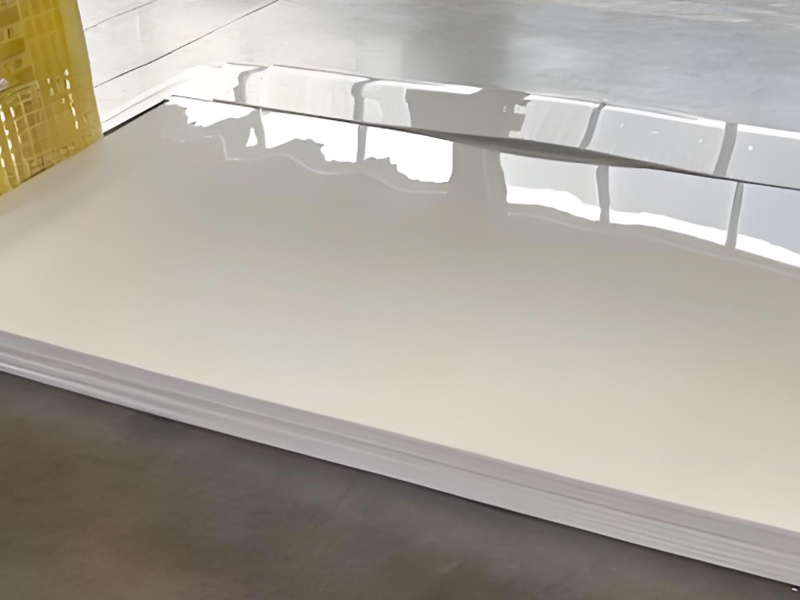
Medical-Grade Natural HDPE Sheet Clean Antibacterial Instrument Pad is produced from undyed, natural-toned HDPE with a dense, smooth, highly clean surface, specifically developed for instrument trays,...
Get In Touch
If you have any questions regarding, feel free to contact us at any time
-
 justin@xinsenplastic.com
-
 +86-13586463708
-
 Shenglong Industrial Park, Wangdian Town, Xiuzhou District, Jiaxing City, Zhejiang Province
Copyright © Jiaxing Xinsen Plastic Co., Ltd.
All Rights Reserved.
Plastic Sheets Manufacturers in China
