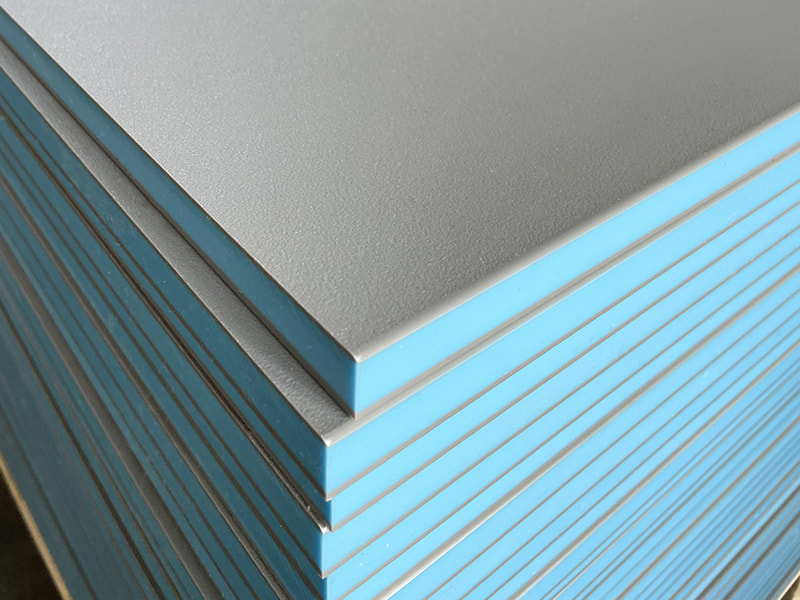
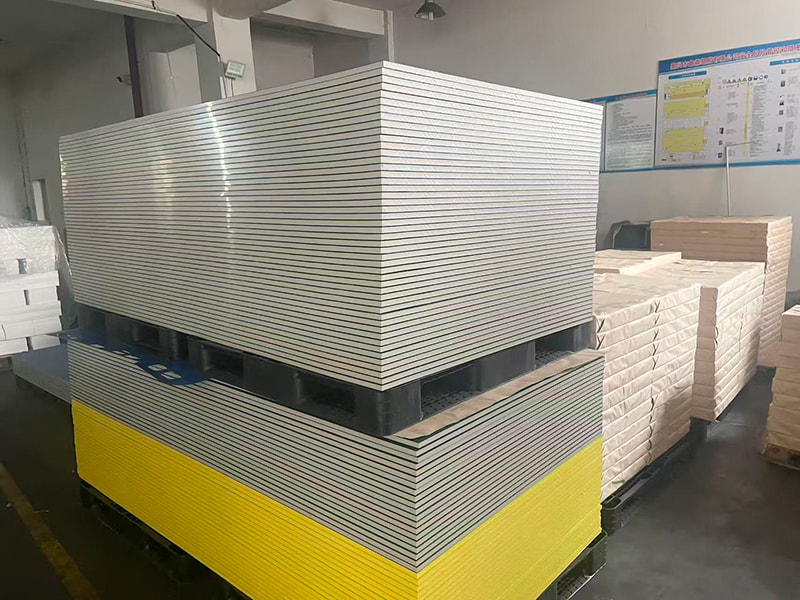
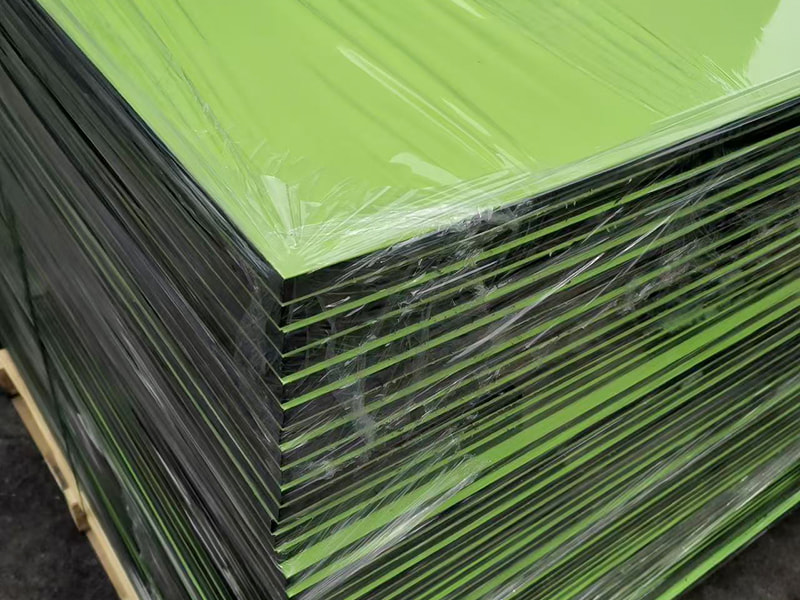
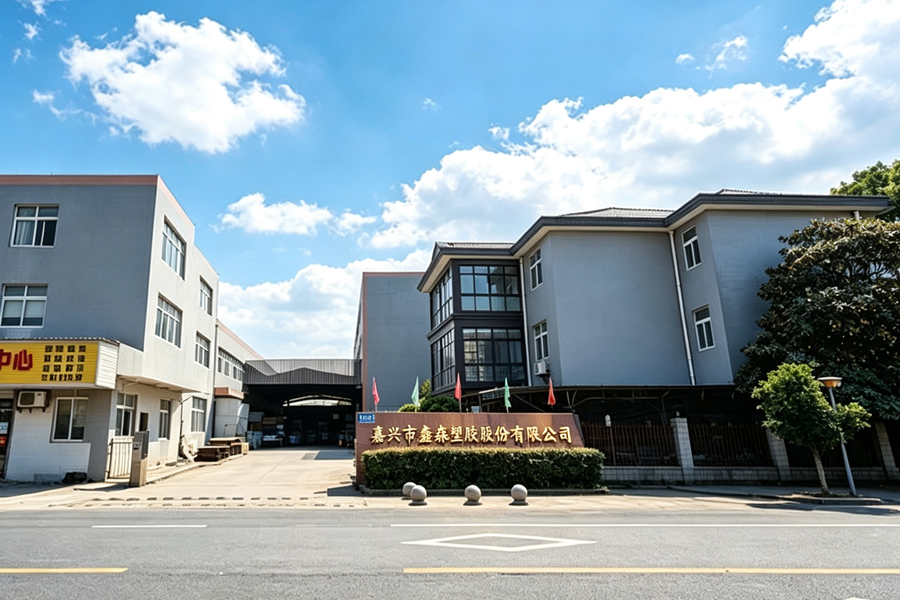
Jiaxing Xinsen Plastic Co., Ltd. manufactures HDPE Two-Tone sandwich Sheet manufacturer production at our plant in Jiaxing, Zhejiang, where we have extruded PP and PE sheet since October 2001. The two-tone construction is produced by multi-layer co-extrusion, so the core and the outer layer carry contrasting colors and a routed or milled graphic stays permanent instead of sitting on the surface as ink or film.
Four production lines with a combined annual capacity above 20,000 tons, more than 20 technical staff and four resident industry experts support this range. Playground equipment, outdoor furniture and signage, marine components, child-safe wall toys, kitchen cutting boards and flame-retardant indoor panels are the applications where dual-color HDPE sheet is specified most often.
How Dual-Color Co-Extrusion Works
A two-tone sandwich sheet is co-extruded with a contrasting cap layer that is bonded to the base layer during extrusion, not laminated afterwards. The color boundary therefore sits at a defined depth inside the sheet. When a CNC router, engraving machine or spindle cuts through the cap, the underlying color is revealed and the pattern, lettering or logo becomes part of the panel itself.
- Two-tone: one contrasting cap over a base color, used for engraved signage, play panels and routed furniture parts.
- Tri-color: a third layer for three-level engraving or a colored edge line — see our HDPE Tri-color sandwich Sheet range.
- Single-color alternative: where no engraving contrast is needed, HDPE Monocolor Sheet keeps the same base polymer without the cap layer.
- Layer ratio: the cap thickness relative to total thickness is the parameter that determines safe engraving depth, and we set it per order.
Our HDPE Two-Tone Sandwich Sheet Range
The two-tone family is divided by service environment rather than by polymer grade, because the base HDPE behaviour is shared across the range. Each item below is produced to order, and the color pair, total thickness, panel size and surface pattern are agreed before the extrusion run.
| Range item |
Construction |
Application fit |
Configuration focus |
| Children's Products Eco-friendly HDPE Two-Tone sandwich Sheet |
Non-toxic HDPE co-extruded in two colors, used on both faces |
Child-safe wall-mounted toys, activity boards, kindergarten furniture, cutting boards |
Color pair, non-toxic and food-contact requirement, surface finish |
| Outdoor engineering HDPE Two-Tone sandwich Sheet |
Contrasting HDPE layers formulated for exterior exposure |
Playground structures, outdoor furniture, engraved outdoor signage, marine trim |
UV resistance, color contrast for routing, panel size for nesting |
| Indoor & Outdoor HDPE Flame-Retardant Dual-Color Sandwich Sheet |
Dual-color construction with a flame-retardant formulation |
Indoor wall panels, partitions, equipment housings, utility boards |
Flame-retardant requirement, panel dimensions, color pair |
Alongside this family we produce modified PP, LDPE, ABS, flexible PVC and EVA sheet, so a project that mixes two-tone HDPE components with HDPE Sheets in plain or natural form can be produced and shipped together.
Material Behaviour and What It Means in Service
The cap layer inherits the physical profile of the HDPE base: wear resistance, impact strength and the ability to absorb repeated mechanical stress without cracking. These properties matter when the finished panel is a playground component, a marine fitting or a cutting surface that is washed and handled daily.
- UV resistance and weather resistance for panels that stay outdoors year round.
- Resistance to acids, alkalis and general corrosion, including marine environments.
- Balanced rigidity and toughness, with resistance to brittle fracture at low temperature.
- Stable electrical insulation, which suits power-engineering concealment and equipment parts.
- Non-toxic, food-grade suitable HDPE for boards that contact food or children.
- Easy machining by sawing, routing, drilling and welding, with a high-contrast engraved finish.
Configuration Options for Custom Production
Customized production is our core business rather than a side service. We develop two-color and three-color sheets to customer requirement, and we handle single-sided and double-sided textured HDPE where grip, gloss control or scratch hiding is needed on the face.
- Surface process: smooth, orange-peel pattern or frosted pattern, produced on our own lines.
- Color development: cap and core colors matched to a supplied sample, shade reference or existing component.
- Geometry: total thickness, layer ratio, sheet length and width, and cut-to-size formats.
- Downstream processing: drawing-based processing and sample production are supported.
- Sampling: a sample part can be produced before batch extrusion so the engraved contrast is verified on the real material.
Fabrication, Installation and Site Handling
Two-tone HDPE behaves like standard high-density polyethylene at the tool, which keeps existing fabrication programmes unchanged. The one process rule that applies specifically to this product is engraving depth: the cutter must stay inside the cap layer so the revealed core color forms the graphic and the base layer remains structurally intact.
- Confirm cap thickness before setting routing depth, especially on thin panels.
- Allow for thermal movement when fixing large outdoor panels; slotted or oversized holes prevent buckling.
- Deburr sawn and routed edges to avoid stress concentrations at corners.
- Welded assemblies — tanks, pipe connections, ducting — use the same HDPE welding practice as monocolor sheet.
Quality Control and Acceptance at Our Factory
We operate full-process quality management: inspection follows each production step, and finished goods receive 100% final inspection against customer requirements and the applicable international standards before packing. A complete set of testing equipment is held on site for material and product checks.
Checks that apply to a two-tone order:
- Incoming polymer and pigment verification before extrusion.
- Layer bonding and color boundary position across the sheet face.
- Surface pattern consistency on smooth, orange-peel or frosted faces.
- Dimensions, thickness and squareness of cut panels.
- Final visual and specification inspection, followed by packed-goods confirmation.
Information We Use to Configure Your Solution
Because our two-tone sheet has no fixed catalogue sizes, the quotation is built from the working point of your product rather than from a stock list. The table below shows the inputs that move a project forward fastest.
| Parameter |
What we need |
How it shapes the proposal |
| Sheet thickness |
Nominal total thickness and the engraving depth needed |
Sets the cap-to-base layer ratio and line setup |
| Panel size |
Finished length × width and quantity per size |
Drives sheet format, cutting plan and nesting efficiency |
| Color pair |
Cap color, core color and a sample or shade reference |
Determines pigment matching and changeover planning |
| Surface finish |
Smooth, orange-peel or frosted; single-sided or double-sided |
Selects the embossing roll and finishing sequence |
| Layer count |
Two-tone or tri-color construction |
Sets the co-extrusion die configuration |
| Service environment |
Outdoor UV exposure, chemical contact, flame-retardant requirement |
Points to the outdoor, flame-retardant or child-safe item in the range |
| Processing scope |
Sheets only, cut-to-size, or drawing-based finished parts |
Defines the machining stage and packing method |
| Order and delivery |
Batch volume, required date, destination port |
Confirms production scheduling, trade terms and freight routing |
Packing, Delivery and Commercial Scope
Our plant sits within a two-hour drive of Shanghai Port and Ningbo Port, and the same road network reaches Shanghai and Ningbo airports when an urgent order has to fly. Sea freight is the normal route; air freight is arranged on request. Trade terms such as FOB or CIF are confirmed at quotation, and batch orders usually run on a 30% advance with the balance against a copy of the bill of lading, by T/T or by negotiated L/C.
Packing is specified together with the order so panels are protected according to their size, surface pattern and end use. We supply to buyers across China and export to North America, South America, Europe, Southeast Asia and Southern Africa.
Frequently Asked Questions
It is a high-density polyethylene sheet co-extruded with a contrasting outer layer over a different-colored core. The two colors are produced in one extrusion process, so when the surface is routed or engraved, the inner color appears and the graphic cannot peel, fade or wash off.
Can you match a specific color pair?
Yes. We develop two-color and three-color sheets to requirement. Send a physical sample, a shade reference or the existing component, and we match the cap and core colors during sampling before the batch run.
Do you hold standard sizes in stock?
Our two-tone sheet is fully customized rather than a standard-parts product. Total thickness, cap thickness, sheet length and width, and cut-to-size formats are all produced to the values agreed for your project, so the specification is confirmed at quotation stage.
Is a flame-retardant two-tone sheet available?
Yes. The Indoor & Outdoor HDPE Flame-Retardant Dual-Color Sandwich Sheet in our range uses a flame-retardant formulation with the same dual-color engraved finish, for wall panels, partitions and equipment housings.
Can you supply machined parts instead of flat panels?
We support drawing-based processing and sample production. Provide the drawings or physical samples and we will assess which operations run in our workshop and which are best handled at your end, then quote the corresponding scope.
What production capacity backs a large order?
Four modern, energy-saving production lines give us an annual output above 20,000 tons, with more than 20 technical personnel and four in-house industry experts. That capacity lets us schedule two-tone runs alongside our PP, LDPE and modified sheet production without splitting quality control.



 English
 Español