

 English
 Español
Amusement Facilities Child-Safe HDPE Tri-color sandwich Sheet is built from three layers of differently colored HDPE fused into a single specialized sandwich structure, allowing layered engraving or r...


News
Home / News / Industry News / HDPE Tri-color sandwich Sheet: Applications, Selection Criteria, and Practical Guidance
HDPE Tri-color sandwich Sheet: Applications, Selection Criteria, and Practical Guidance
2026-10-27
Content
- 1 What an HDPE Tri-Color Sandwich Sheet Actually Is
- 2 Why the Sandwich Build Matters More Than the Color Match
- 3 Layer Thickness, Tolerance and Edge Quality: What to Put on the Drawing
- 4 Where Tri-Color Sandwich HDPE Earns Its Keep
- 5 A Six-Point Checklist Before You Release the PO
- 6 Frequently Asked Questions
Color is rarely the reason a tri-color HDPE order gets rejected. Skin thickness is. A buyer who asks for a black core with grey faces at 12 mm overall has described a look; a buyer who also fixes skin thickness per face, core centering and a tolerance on both has described a sheet that still looks right after the first chamfer.
That distinction matters because a tri-color sandwich sheet is bought for the edge. The face is only half of the story, and the band of contrasting core running along every cut edge is what playground designers, signage fabricators and marine contractors are actually paying for.
What an HDPE Tri-Color Sandwich Sheet Actually Is
An HDPE tri-color sandwich sheet is a polyethylene panel made by three-layer co-extrusion, in which a pigmented core is fused between two HDPE skins of different colors in a single die pass.
Definition: an HDPE tri-color sandwich sheet is one continuous polyethylene panel with a colored core layer bonded between two surface skins during extrusion, so that sawing, routing or chamfering exposes the core as a clean color band with no adhesive line.
The three layers are not glued. They leave the die as one melt and cool as one solid sheet, which is why a properly built sandwich panel does not delaminate when it is machined, thermoformed or fixed with screws close to an edge.
- Skin layers: HDPE compound carrying the pigment, usually with a UV stabilizer for outdoor service.
- Core layer: normally the thickest of the three, often a darker or denser grade because it is never seen until the panel is cut.
- Co-extruded bond: no glue and no lamination, so the color band stays crisp through sawing, routing and edge polishing.
Two look-alike products cause most of the confusion in this category. A laminated sheet is a thin colored film stuck onto a standard HDPE core, and its edge shows a hairline of adhesive rather than solid color. A painted or printed sheet puts the color on the surface only, so a router bit cuts straight through it. If the edge has to carry the design, the color has to be in the melt.
Why the Sandwich Build Matters More Than the Color Match
The sandwich build does three jobs at once: it holds cost down, it stabilizes the panel, and it puts the color exactly where the edge is.
3 Co-extruded layers fused in one die pass, with no adhesive interface
3-25 mm Typical overall thickness band for sandwich HDPE sheet, confirmed per grade
2 faces Independent skin colors plus a contrasting core visible on every edge
Cost is the first driver. The core is the thickest layer and does not have to be the most expensive compound in the sheet, so a producer can keep both skins as virgin, UV-stabilized material while the core runs a darker, denser grade. The visible result on the face is identical; the price per square metre is not.
Single color sheet
- One pigment through the full thickness
- Edge reads the same as the face
- Simpler to quote at equal thickness
- Cut lines disappear into the surface
Tri-color sandwich sheet
- Contrasting core on every cut edge
- Face colors changed without touching the core
- Requires a written skin thickness spec
- Edge becomes a design line, not a hidden detail
The third job is the one buyers underrate: core centering. If the core sits off-centre, one skin is thinner than the drawing says, and that is the face that shows scratches and core bleed first.
Layer Thickness, Tolerance and Edge Quality: What to Put on the Drawing
Specify skin thickness in millimetres per face, never as a percentage of total thickness, and require the tolerance on that number in writing. It is the single line that separates a quote you can compare from a quote you cannot.
| Parameter | Specify as | Why it matters |
| Overall thickness | Fixed value in mm, for example 8, 12 or 15 mm | Sets stiffness, weight and fixing depth |
| Skin thickness | Value per face, typically 0.5 mm to 1.5 mm | Thin skins bleed core color on chamfers |
| Thickness tolerance | Plus or minus 0.2 mm, or an agreed value | Panels differing by 0.5 mm break flush joints |
| Core centering | Even color band on all four edges | Off-centre core means one skin is under spec |
| Sheet size | 1220 x 2440 mm, or cut to size | Factory cutting keeps edge quality controlled |
| Surface | Smooth, matte or orange peel texture | Changes slip resistance and cleaning routine |
| Color match | Physical sample or Pantone reference | Batch-to-batch drift is the common complaint |
Ask for a cut-edge sample at the production thickness. A face sample proves the color; only an edge sample proves the skin spec.
Two numbers are usually missing from a first enquiry: skin thickness and core centering. Both are invisible on a face-on sample, and both decide whether the finished panel looks intentional. Thickness conventions and grade selection for polyethylene are covered in more depth in this HDPE sheet grades and thickness tolerance guide, including how tolerance is normally written onto a purchase order.
Where Tri-Color Sandwich HDPE Earns Its Keep
Two application families dominate: places where children see the edge, and places where salt water does.
Playground and amusement equipment is the largest. Climbing panels, play towers, decking, themed cladding and signage all use the core band as a design line, and the same panel takes impact without splintering or leaving a sharp edge. For child-facing projects, ask for the material declaration behind any child-safe or eco-friendly claim, then match it against the rules of the destination market rather than the wording of a brochure.
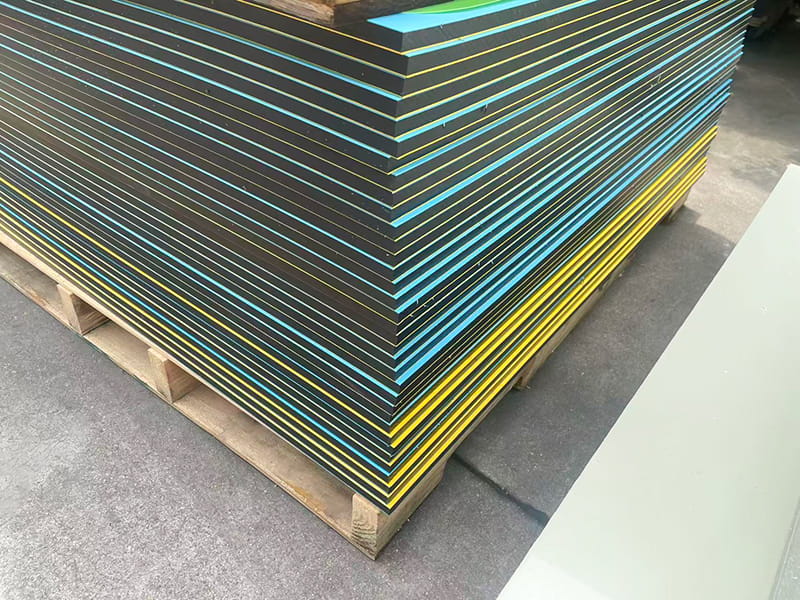 Child-Safe Tri-Color HDPE Sandwich Sheet for PlaygroundsThree fused HDPE color layers reveal distinct tones when routed, and edges can be rounded for child-facing playground and amusement equipment.View Product →
Marine and industrial work is the second. Dock bumpers, fenders, splash guards, tank covers and washdown partitions use a dark core as a wear indicator: when the face color starts to break through, maintenance can see how deep the damage runs without a gauge. Anti-corrosion panels in this family are usually specified by thickness, fixing method and expected salt-spray exposure rather than by color alone.
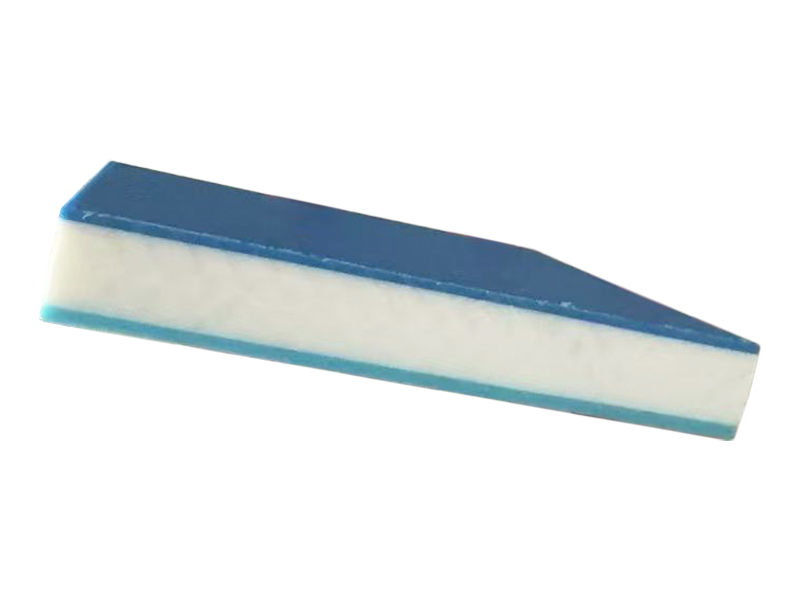 Marine-Grade HDPE Anti-Corrosion Tri-Color Sandwich PanelFor docks, marine accessories and industrial protection, this HDPE sandwich panel resists salt spray and chemicals and reveals core color on cut edges.View Product →
- Signage and wayfinding, where the contrasting edge acts as a built-in border.
- Furniture and partitions that need an exposed edge with no laminate to peel.
- Machine guards and covers, where thickness should be visible at a glance.
- Outdoor play structures and climbing walls in public parks and schools.
- Dock trim and pontoon edging in salt-spray environments.
A Six-Point Checklist Before You Release the PO
- Name the application and the expected service life. A five-year indoor signage panel and a fifteen-year seaside fender need different skin thicknesses even at identical overall thickness.
- Write skin thickness per face, plus the tolerance. A drawing that says only 12 mm tri-color leaves the most expensive variable to the supplier.
- Request a cut-edge sample and a face sample from the same production run. Color on a screen and color on a 1220 mm sheet are two different things.
- Confirm core color against the face colors. A black core with a dark navy face reads as one mass at a distance; a light core with a dark face reads as a stripe.
- Fix the test method for thickness and centering in the order. Who measures, with what, and at how many points along the edge.
- Plan freight and cutting before the color is locked. Oversized sheets and cut-to-size panels carry different shipping costs, and cutting at the factory protects the edge you paid for.
Frequently Asked Questions
Does tri-color mean three visible colors at once?
Yes, once the panel is cut. The top skin, the core band on the edge and the bottom skin each show a color, so a sheet with grey faces and a black core reads as three tones on any routed or sawn edge while looking single-colored on the face.
Can the core color be customized?
Custom colors are produced by compounding pigment into the core layer, so most manufacturers treat core color as a development item with a minimum run length. Confirm the batch size, the color reference and the lead time before the color goes onto a drawing.
Will the color band survive CNC routing and edge polishing?
It survives if the skins are thick enough for the chamfer. A 0.5 mm skin on a heavy radius exposes core color across the whole curve; a 1.2 mm skin keeps the face color intact around normal edge profiles. State the profile depth when you ask for the sample.
Is a tri-color sandwich sheet recyclable?
All three layers belong to the same polyethylene family and there is no adhesive between them, which makes regrinding more practical than for laminated or coated boards. Ask the producer how they handle pigmented regrind, since mixed colors limit what the scrap can become.
Jiaxing Xinsen Plastic has been extruding plastic sheet since October 2001 from its own plant in Jiaxing, Zhejiang, within easy reach of the Shanghai and Ningbo ports. Three-layer co-extrusion, smooth, matte and orange peel surfaces, and color development to a drawing or sample are all handled in-house, which is useful when a tri-color panel has to match a face color and a core color at the same time. The full HDPE tri-color sandwich sheet range lists the standard build, and cut-to-size orders can be quoted against a thickness and skin specification rather than a catalog number.
Related products
-
-
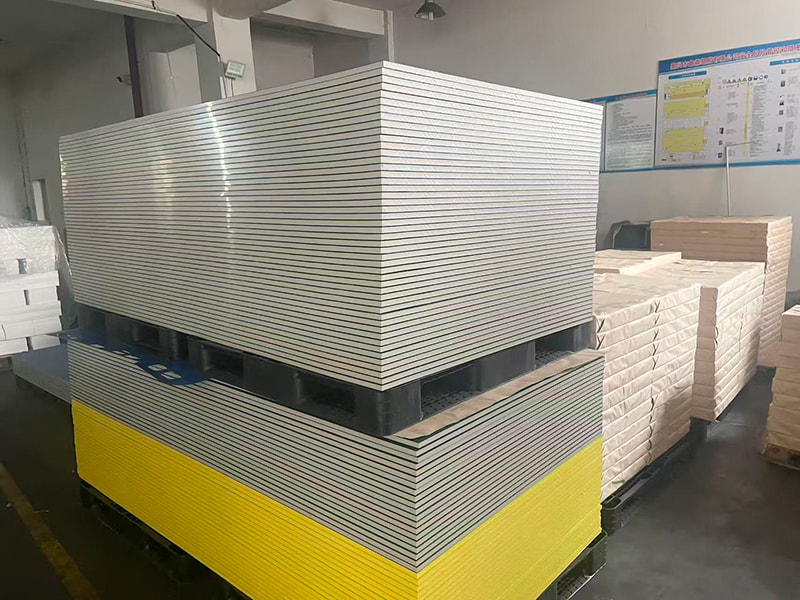
Outdoor engineering HDPE two-tone sandwich sheet is built from two layers of HDPE in contrasting colors fused into a single sandwich structure, with a distinct surface tone over a differently colored ...
-
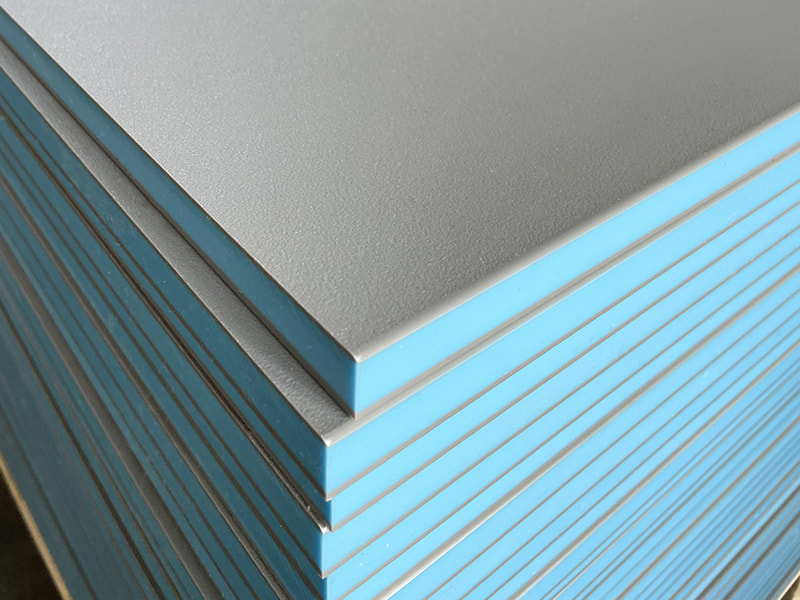
Children's Products Eco-friendly HDPE Two-Tone sandwich sheet is specifically developed for child-related products, combining two layers of contrasting-colored HDPE into a single sandwich structure wi...
-
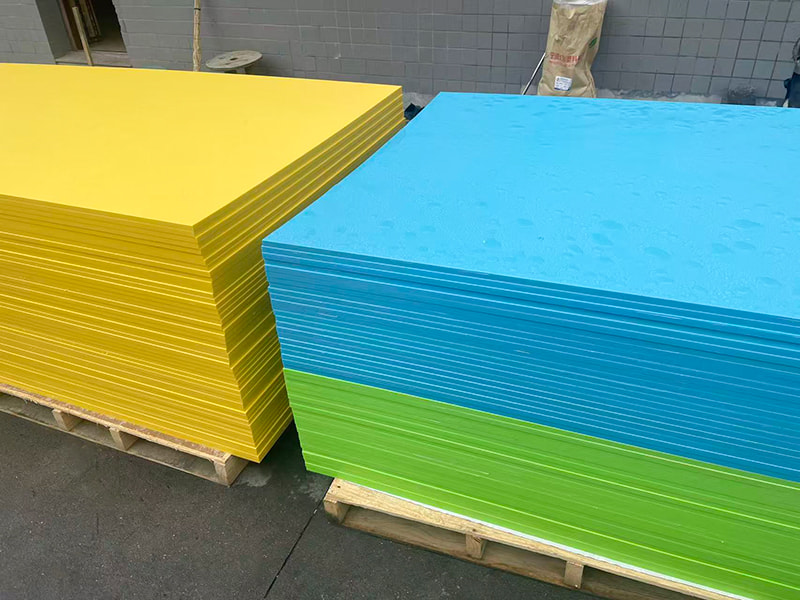
High-density polyethylene (HDPE) monocolor sheet stands out as an engineering material of choice across an unusually broad range of industries, with applications spanning playground equipment, outdoor...
-

HDPE monocolor sheet is engineered to be fully waterproof while delivering a well-rounded set of physical and chemical performance characteristics, making it suitable for a remarkably wide range of in...
Get In Touch
If you have any questions regarding, feel free to contact us at any time
-
 justin@xinsenplastic.com
-
 +86-13586463708
-
 Shenglong Industrial Park, Wangdian Town, Xiuzhou District, Jiaxing City, Zhejiang Province
Copyright © Jiaxing Xinsen Plastic Co., Ltd.
All Rights Reserved.
Plastic Sheets Manufacturers in China
